Wednesday, February 2, 2011

1900s-Modern Cannon, Part 1

Autocannon
These are usually smaller in design than the field gun; they are mechanically loaded to achieve a faster rate of fire. They fire rapidly and fire shells, as opposed to bullets. They can overheat if used for sustained fire.
They are similar to a large machine gun, except that, unlike a machine gun, thay fire explosives. The autocannon has fully automatic firing, and they need either carriage or mounting to absorb recoil. They also have great range and penetration capabilities.
History:
1. They began with the Puckle gun: a heavy, tripod-mounted, single-barreled gun.It could fire and reload much faster, but it failed to stir up much interest.
2. The first modern autocannon was the QF 1 Pounder; it was also known as the "pom-pom gun." It was the first fully automatic machine gun.
3. In World War 1, autocannon were used as anti-aircraft guns in the trenches; they defended against German zeppelins' bombings. The QF 2 Pounder navy gun was developed for anti-aircraft and as a close-range defensive weapon for naval vessels.
4. Autocannon experienced much greater usage in World War 2. Heavier anti-aircraft cannon could not track the faster planes, and machine guns lacked range and fire power.
5. German Panzer II used autocannon as its main armament during the invasion of Poland and the Battle of France. It could penetrate tank armor at close ranges.
6. Autocannon could strike anywhere on an aircraft and could cause enough harm to make the aircraft inoperable.
The Luftwaffe experimented with heavy aircraft cannon.
 

Social and Economic Impacts
Because of these weapons' success in World War II, they are still in great usage today; they are very versatile forms of weaponry.

1800s-1900s Cannon, Part 1

Field Artillery in the American Civil War
12-Pounder Napoleon
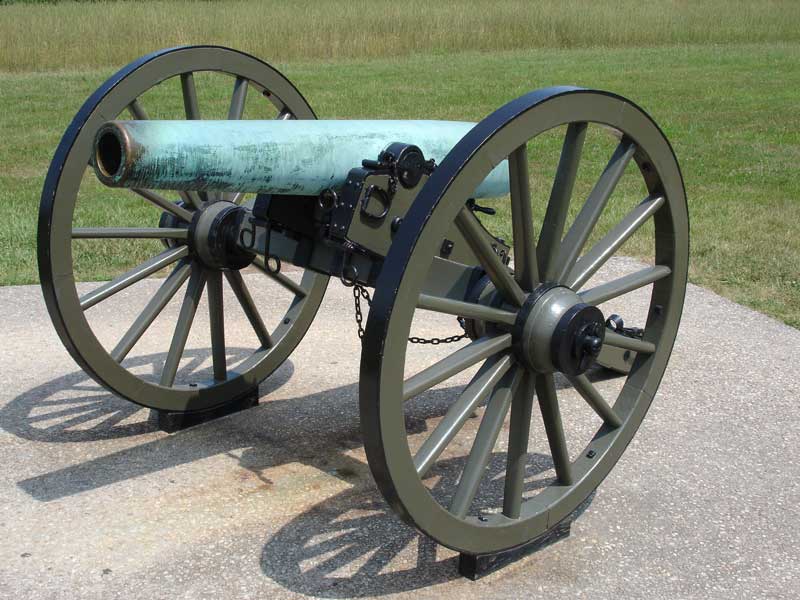
These cannon were made of cast bronze with a flared front-end barrel, called a muzzle-swell. They were safe, reliable, and had amazing killing power, particularly at a close-range.
File:CW Arty M1857 Napoleon front.jpgFile:CW Arty M1857 Napoleon rear.jpgFile:CW Arty Confederate Napoleon.jpg

Howitzers
These cannon were short-barreled and fired explosive shells at a high trajectory. They worked best if enemies were concealed behind terrain or some sort of fortifications. They had lower powder charges and mainly consisted of bronze.


Economic Impacts
At this period in time, the South was at a great disadvantage to the North in terms of weapons production. The North had plenty of factories to create weapons, as well as troops who were generally much better trained than the Confederate troops.

Social Impacts
The South's lack of weaponry in comparison to the North had an impact on the outcomes of various points in the Civil War. If the South had had as great a number of artillery as the North, the war might have had a different ending.

Tuesday, February 1, 2011

Pre-1800s Cannons, Part 1

Naval Artillery in the Age of Sail

In the Age of Sail, naval warships dominated the waters. These cannon were used from 1571 to 1863. Because they could weigh over two tons, much manual labor was necessary. Their propellant was gunpowder, and they had to be kept in special storage below deck for safety and had to be brought up by "Powder Boys." They were inefficient, hard to be loaded, and short-ranged.
Preparation
1. The interior barrel was cleaned out with a wet swab to extinguish embers from previous firings and keep it from going off prematurely.
2. The gunpowder, followed by a wet cloth were inserted into the barrel and then rammed home.
3. Another shot was rammed in, then another cloth to prevent the shot from falling out.
4. It was then "run-out"; the gun tackles were heaved on, the carriage was pushed up against the ship's bulwark, and the barrel protruded out of the gun port.
5. The "breech", which was the touch-hole in the rear, was filled with fine, priming gun powder, then ignited.

Ignition
1. Linstock was applied with a wooden staff, holding the length of a burning match at the end to the touch hole; this was very dangerous and accuracy from a moving ship was extremely difficult.
2. Gunlocks, which were flintlock mechanisms fitted to the cannon, a cord or lanyard was pulled, and the cannon was fired when the movement of the ship was aligned properly with the enemy.
3. They could be fired around two to three times in approximately five minutes.

Battles
These were used in the Battle of Trafalgar in 1805.
This type of cannon was adopted by the British faster than by the French, so the French were at a horrible disadvantage.   

Economic Impacts
The type of cannon described above was mainly used by the British Royal Navy at first. This gave them a good advantage over their enemies, such as the French, who were still not utilizing this sort of weaponry.

Social Impacts
Because the British made great usage of these weapons, their navy dominated the high seas during this time period.